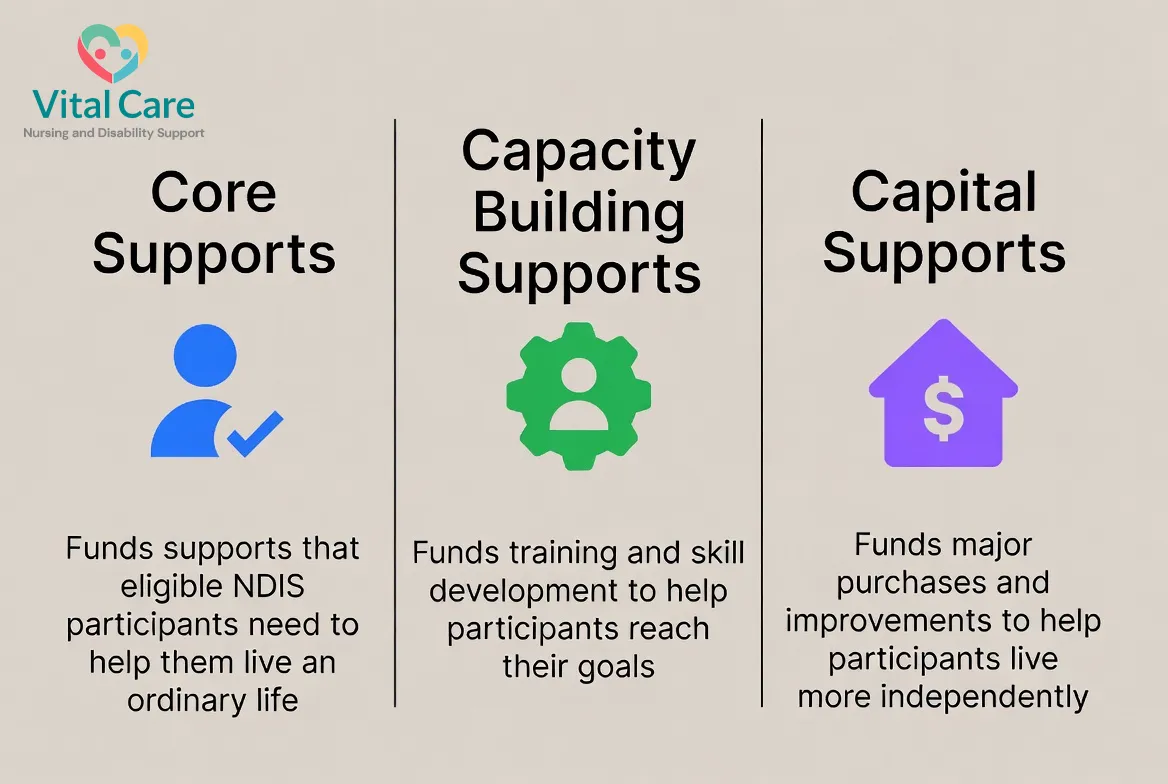
Your NDIS plan is divided into three main budget categories, each designed to fund different types of supports based on your goals and needs. Understanding these categories helps you make the most of your funding and achieve your goals.
The Three Budget Categories
1. Core Supports Budget
What It Funds:
Core Supports are flexible funding for your everyday needs. This budget can be used across four sub-categories:
Assistance with Daily Life
- Personal care and support workers
- Help with household tasks (cleaning, cooking, gardening)
- Community access and social participation
- Respite care
- Nursing services (community nursing, medication support, clinical care)
Consumables
- Continence products
- Low-cost assistive technology under $1,500
- Nutrition supplements (if disability-related)
- Wound care supplies
Transport
- Getting to and from appointments
- Community participation transport
- Modified vehicle costs (if pre-approved)
Assistance with Social & Community Participation
- Support to attend social activities
- Sporting clubs or recreational activities
- Day programs
Key Feature: Core Supports funding is flexible - you can move money between these four sub-categories as needed without asking for plan variations.
Example: If you don't use all your transport budget, you can redirect that funding to pay for more support workers.
2. Capacity Building Supports Budget
What It Funds:
Capacity Building helps you build independence and skills for the future. This budget is category-specific - you must use funding for the purpose it was allocated.
Key Capacity Building Categories:
- Support Coordination - Help understanding and using your plan
- Improved Living Arrangements - Finding suitable accommodation
- Increased Social & Community Participation - Life skills development
- Finding & Keeping a Job - Employment support and modifications
- Improved Relationships - Communication and social skills
- Improved Health & Wellbeing - Exercise physiology, dietetics, behavioral support
- Improved Learning - Educational and skills training
- Improved Life Choices - Decision-making support, plan management
- Improved Daily Living - OT, physio, speech therapy
Key Feature: Capacity Building funding is not flexible - you cannot move funding between these categories without a plan variation.
3. Capital Supports Budget
What It Funds:
Capital Supports are for high-cost, one-off purchases of equipment and home modifications.
Assistive Technology
- Mobility aids (wheelchairs, walkers, scooters)
- Communication devices
- Hearing aids
- Specialized seating and hoists
- Assistive technology over $1,500
Home Modifications
- Ramps and rails
- Bathroom and kitchen modifications
- Widened doorways
- Home automation for accessibility
Key Feature: Capital funding is quote-specific - you need quotes and assessments before purchases.
How Your Plan Is Managed
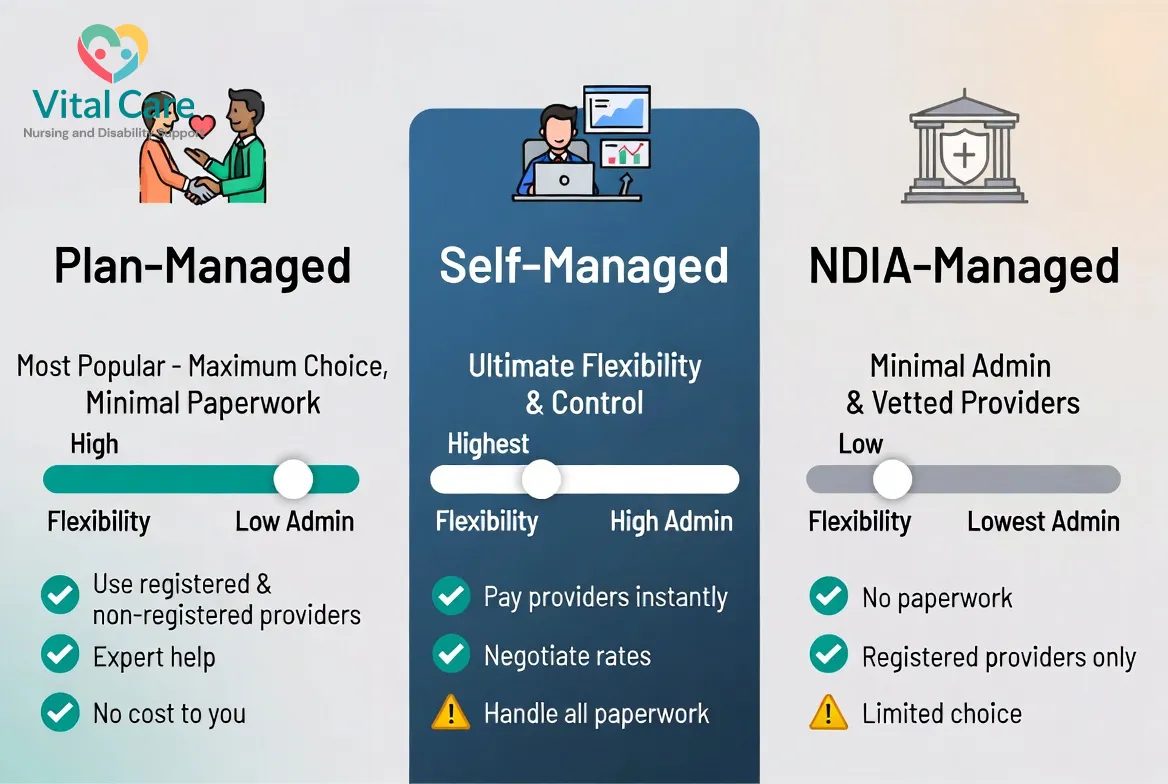
Your NDIS plan will specify how each budget category is managed:
- Plan-Managed: A plan manager pays providers on your behalf; you can use registered and non-registered providers
- Self-Managed: You manage all payments and claims yourself; maximum flexibility
- NDIA-Managed: The NDIA pays providers directly; you can only use registered providers
Important: You can have different management types for different budget categories.
Making the Most of Your Plan
Tips for Using Your Budget Effectively:
- Know Your Budget Breakdown - Ask for detailed breakdowns
- Track Your Spending - Use myplace portal or plan manager statements
- Use Core Supports Flexibly - Remember funding can be moved within Core categories
- Plan Ahead for Capital - Get quotes early
- Don't Let Funding Expire - Use it before your plan ends
- Request Variations When Needed - If your needs change significantly
When to Request a Plan Review
You can request an early plan review if:
- Your disability needs have changed significantly
- Your living situation has changed
- You're consistently under-spending or over-spending
- You need supports that weren't included
- Your goals have changed
Common Questions
Q: Can I save unused funding for next year?
A: No, NDIS funding does not roll over. Unused funding expires at the end of your plan.
Q: What if I run out of funding before my plan ends?
A: Contact your support coordinator or LAC immediately to request an early review.
Q: Can I change how my plan is managed?
A: Yes, but it will take effect at your next plan review.
Need Help Understanding Your Plan?
At Vital Care, our Registered Nurse can help you understand how to use your Core Supports budget for nursing services, and our team can connect you with support coordinators who can help you navigate all aspects of your plan.
Ready to get started?
Book a Free ConsultationReferences & Further Reading
📋 Important Disclaimer
This article provides general information only and is based on current NDIS policies and guidelines. It is not personalized advice for your specific situation.
For advice about your individual circumstances, please contact:
- Your NDIS planner or Local Area Coordinator (LAC)
- Your support coordinator
- The NDIA directly: 1800 800 110
Last Updated: January 25, 2026 | NDIS policies and procedures may change. Please verify current information with official NDIS channels.